

Why Base Rent Isn’t the Whole Story
Two apartments with the exact same advertised rent can easily cost very different amounts each month. We see this confusion happen every day when clients look at their options. When you compare communities on your apartment list, you must focus on the total monthly obligation instead of just the headline number.
In 2026, the Federal Trade Commission actually proposed new rules targeting these hidden rental “junk fees” because they mislead so many renters. Our team constantly reminds clients that base rent is only a starting point. Properties frequently exclude mandatory costs like water, tech packages, pest control, and pet rent from their primary advertising.
This guide breaks down every component of your apartment total monthly cost, rent, utilities, and fees so you know exactly what to expect.
We will give you a simple, proven way to compare these costs side by side. Evaluating the full financial picture ensures you make the best decision for your budget.
The Parts of Monthly Cost
Your actual monthly apartment cost combines your base lease amount with utilities, required community fees, and insurance. We break this down into specific categories so you can clearly see where your money goes. Every property structures these fees differently.
- Base rent: This is the primary rent amount listed in your lease agreement. Properties sometimes advertise a lower “effective” rent that factors in a move-in special, so always confirm the actual recurring monthly rate.
- Utilities you pay: Electricity is almost always the tenant’s responsibility in Texas. Other services like water, sewer, trash, and gas will vary significantly by building. You should always ask the leasing office exactly which utilities you must set up directly.
- Mandatory monthly fees: These required charges are often the biggest surprise for new renters. A 2024 University of Texas at Austin report identified valet trash and pest control as the most common add-on charges in the state. Our data shows that mandatory valet trash fees now typically cost renters $25 to $35 per month. Properties rarely let you opt out of these community packages.
- Pet rent: Communities usually charge a monthly fee per pet. This is an ongoing cost applied on top of your initial pet deposit or one-time fee.
- Renter’s insurance: Most modern properties require active liability coverage. You will pay for this policy separately either monthly or yearly.
A quick rule
Total monthly cost = base rent + utilities you pay + mandatory fees + pet rent + required insurance.
Utilities and the Utility Allowance

A utility allowance is a specific deduction used in income-restricted housing to ensure your total housing costs remain within program limits. We help clients understand this process because it directly impacts your maximum allowable rent. When a tenant pays their own utilities, the property subtracts this estimated allowance from the maximum gross rent.
This housing allowance is a calculated formula, not a guarantee of your actual monthly bills. The 2026 Fair Market Rent limits published by HUD use strict local standards to set these utility allowances. Our experience shows that a typical one-bedroom allowance might hover around $85 to $100 depending on your local Public Housing Agency. Your real utility costs will fluctuate based on the unit layout, the season, and your personal habits.
Texas summers routinely push electricity usage to the extreme. You should always ask the property manager for a history of typical summer utility bills for your specific unit size. Our guide on how tax credit rent limits work explains the utility allowance formula in much more detail. Getting familiar with these rules protects your household budget.
Deposits and Move-In Costs
Move-in costs are the necessary one-time charges you must pay before or on the day you receive your keys. We always advise clients to budget carefully for these upfront expenses. Understanding your full apartment move in costs prevents financial stress during your transition.
Texas law currently places no statutory cap on apartment application fees, meaning landlords can charge any amount. The average application fee across the state in 2026 ranges from $50 to $75 per adult. Our research indicates that luxury high-rise communities often push these non-refundable fees up to $150 per applicant. These costs add up rapidly when applying to multiple buildings.
Here is a breakdown of the typical move-in charges you will encounter:
- Application fee, typically charged per adult applicant
- Administrative fee to process the lease
- Security deposit, which frequently changes based on your credit screening
- Pet deposit or a one-time non-refundable pet fee
- First month’s rent, which is sometimes prorated based on your move-in date
- Utility connection deposits, required if you set up service directly with providers
Because these application fees are unregulated and non-refundable, you should narrow down your top choices before applying to multiple properties. We recommend asking the leasing staff which specific fees are refundable if your application is denied. Getting the complete fee list in writing protects you from last-minute surprises.
A Simple Comparison Worksheet
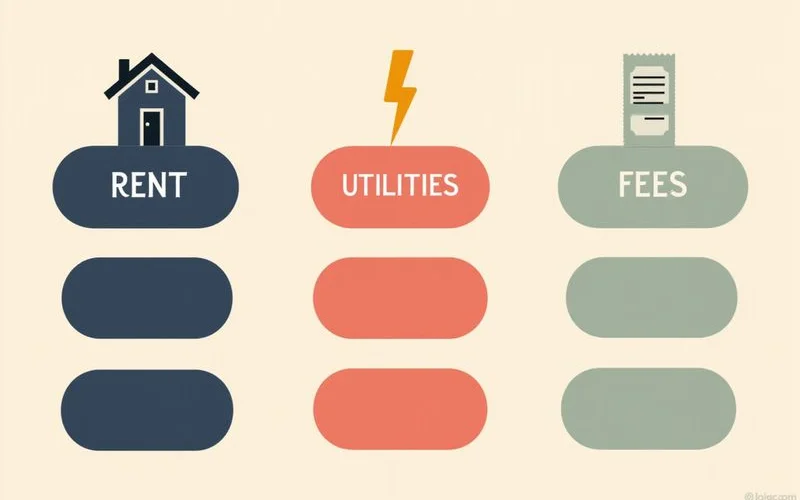
Organizing your data side by side is the only reliable way to evaluate competing apartment offers. We suggest using a standardized worksheet to track every single charge. Recent consumer surveys show that 40% of renters discover unexpected monthly charges after signing their lease.
You can easily prevent this common trap by documenting the verbal quotes you receive during property tours. Fill in the specific amounts each leasing agent provides for their respective community.
| Cost item | Community A | Community B | Community C |
|---|---|---|---|
| Base rent | |||
| Utilities you pay (estimate) | |||
| Mandatory monthly fees | |||
| Pet rent | |||
| Required insurance | |||
| Total monthly cost | |||
| Security deposit | |||
| Application and admin fees | |||
| Estimated move-in cost |
If you prefer an automated approach, our total monthly cost calculator adds everything up for you instantly. This digital tool ensures you never miss a hidden fee in your final budget.
Texas Costs That Are Easy to Miss
Certain regional expenses frequently catch new Texas residents completely off guard. We have compiled a list of the most easily overlooked costs in our state. Asking about these specific items turns a rough estimate into a highly accurate monthly budget.
- Summer electricity: Air conditioning makes July and August bills significantly higher than spring statements. Large apartments routinely see summer electric bills jump to $250 or even $300 in peak heat. You must ask about the age of the unit’s windows and AC system, as older hardware drastically reduces efficiency.
- Choosing an electricity provider: Renters pick their own retail electricity plan in many deregulated areas of Texas. The statewide average electricity rate hovers around 15.8 cents per kWh in 2026. Comparing plan rates and contract terms before you sign up is absolutely essential.
- Valet trash and pest control: These convenient services are common mandatory apartment fees Texas properties enforce. Ask the leasing office immediately whether these charges are optional or required.
- Water submetering or billing services: Some communities bill your water, sewer, and trash through a third-party billing service. These billing companies frequently add their own monthly administrative charge to your statement.
- Parking: Covered parking, private garages, or reserved surface spaces usually cost extra.
- Flood or renter’s insurance: Almost all properties require standard renter’s insurance. If you rent in a flood-prone area, you need to clarify exactly what water damage your policy covers.
Our team highly recommends reviewing this checklist before you sign any legally binding documents. Every dollar you identify upfront gives you more negotiating power and peace of mind.
What Your List Includes
Your provided property list shows the researched base rent for your desired bedroom size alongside the date the information was verified. We also include published mandatory fees and standard deposits whenever that data is publicly available. Many hyper-local property management charges do not syndicate correctly to Multiple Listing Service (MLS) or third-party property management sites.
Because these internal fees are rarely fully published online, some items on your list will be marked as needing direct confirmation. Common fees that require in-person verification include:
- Monthly pet rent variables based on breed or weight
- Dynamic parking fees for reserved spaces
- Package locker technology subscriptions
- Required community event or amenity fees
Our staff uses this preliminary list as a strategic starting point for your search. You will then fill in the missing details on your worksheet as you speak directly to each property manager. Relying solely on digital listings is a common mistake that leads to budgeting errors. We encourage you to treat online prices as estimates until a leasing agent hands you an official, written fee schedule. Getting everything in writing is the smartest way to protect yourself.
Comparing Across Apartment Types
A tax credit unit with a legally capped rent may still cost you more in total than a standard market-rate unit with utilities included. We want you to analyze the apartment total monthly cost, rent, utilities, fees, and deposits before making your final housing decision. A property utilizing a lower minimum-income requirement might offset that benefit by charging significantly higher monthly fees.
You must compare the complete total cost instead of relying on the specific housing program type alone.
Make sure this comprehensive total comfortably fits the financial budget you shared in your initial request. Our recommendation is to have each community explicitly confirm its current rents, fees, deposits, and utility responsibilities in writing. Taking these final steps ensures you secure the perfect apartment without compromising your financial stability.